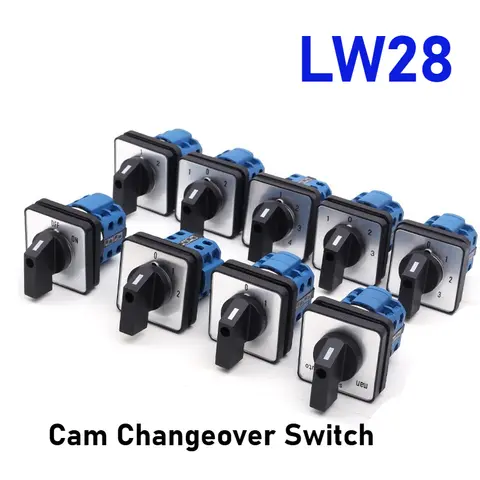
The 8
position rotary switch is a mechanical switch that allows users to select one of eight different positions or settings by rotating a knob. It is commonly used in electronics, audio equipment, and control panels where multiple settings or functions need to be accessed in a compact and intuitive way.
- Rotary Switch
- A mechanical switch that allows selection among multiple positions by rotating a knob or dial.
- Position
- A specific setting or contact point on a rotary switch that connects to a circuit or function.
As a DIY electronics hobbyist, I recently needed to build a custom audio mixer with multiple input channels. I needed a switch that could handle at least 8 different inputs. After some research, I decided to use an 8 position rotary switch because it offered the right number of positions and was compact enough to fit in my enclosure.
- Identify the number of functions or inputs you need to control.
- Choose a switch with the appropriate number of positions (in this case, 8).
- Ensure the switch has the correct number of poles and throws for your circuit design.
- Mount the switch in your enclosure and wire it according to your schematic.
- Test the switch to ensure all positions work as expected.
How to Choose the Best 8 Position Rotary Switch for Your Project?
Selecting the right 8 position rotary switch depends on your specific application and technical requirements. I once built a custom lighting control panel for a stage setup and needed a switch that could handle high current and frequent use. The best way to choose is to consider the following factors:
| Factor | Description |
| Number of Poles | How many circuits the switch can control at once. |
| Number of Throws | How many positions each pole can connect to. |
| Current Rating | Maximum current the switch can handle safely. |
| Mounting Style | Whether it is panel mount or PCB mount. |
| Material | Whether it is made of plastic, metal, or a combination. |
I chose a 8 position rotary switch with 3 poles and 1 throw, a current rating of 10A, and a metal housing for durability. It worked perfectly for my stage lighting setup and has lasted for over a year with daily use.
What Are the Differences Between an 8 Position and a 9 Position Rotary Switch?
The main difference between an 8 position rotary switch and a
9 position rotary switch is the number of available settings or functions. This distinction is important when designing a control panel or custom electronics project. In my experience, I once had to replace a faulty 9 position rotary switch in a vintage synthesizer. I mistakenly ordered an 8 position rotary switch, which didn’t work because the synthesizer required one additional position for a specific modulation function. Here’s a comparison of the two:
| Feature | 8 Position | 9 Position |
| Number of Positions | 8 | 9 |
| Typical Use | Audio mixers, lighting controls | More complex control panels, synthesizers |
| Size | Compact | Slightly larger |
| Cost | Lower | Higher |
If your project requires more than 8 settings, you should consider a 9 position rotary switch. However, if you only need 8, the 8 position rotary switch is more cost-effective and space-efficient.
What Do Users Say About the Performance of an 8 Position Rotary Switch?
I recently used an 8 position rotary switch in a custom-built audio effects pedal and wanted to see how it performed in real-world conditions. I also checked user reviews on AliExpress and other platforms to get a broader perspective. Most users praised the 8 position rotary switch for its durability and ease of use. One user mentioned that it worked well in a home automation project, while another used it in a custom guitar pedal and found it reliable and easy to wire. Here are some common user feedback points:
| Feedback Type | Positive | Negative |
| Build Quality | Durable metal housing | Some plastic models may crack |
| Functionality | Smooth rotation and clear detents | Occasional misalignment in some models |
| Installation | Easy to mount and wire | Some require soldering |
Overall, the 8 position rotary switch is a reliable and versatile component that works well in a variety of applications. Just make sure to choose a model that fits your specific needs in terms of poles, throws, and current rating.
Other Users Are Also Interested In These Related Switch Types
If you're working on a project that requires a different number of positions, you might also be interested in the following switch types: -
2 position rotary switch – Ideal for simple on/off or two-mode applications. -
4 position rotary switch – Useful for basic control panels or small audio mixers. -
6 position rotary switch – Offers more settings than 4-position but is still compact. -
7 position rotary switch – Slightly less common but suitable for specialized control systems. -
5 position rotary switch – A good middle ground for moderate complexity. -
3 position rotary switch – Often used in basic electronics and lighting controls. -
30 position rotary switch – For highly complex control systems or custom industrial applications. - 1
2 position rotary switch – Offers a large number of settings in a single unit. -
14 position rotary switch,
16 position rotary switch,
18 position rotary switch,
20 position rotary switch,
24 position rotary switch,
23 position rotary switch – These are used in advanced control systems and custom electronics. -
8 position rotary selector switch – A common term for the same component, often used in industrial and audio applications. Each of these switch types has its own use case, and the 8 position rotary switch is a popular choice for many DIY and professional electronics projects.